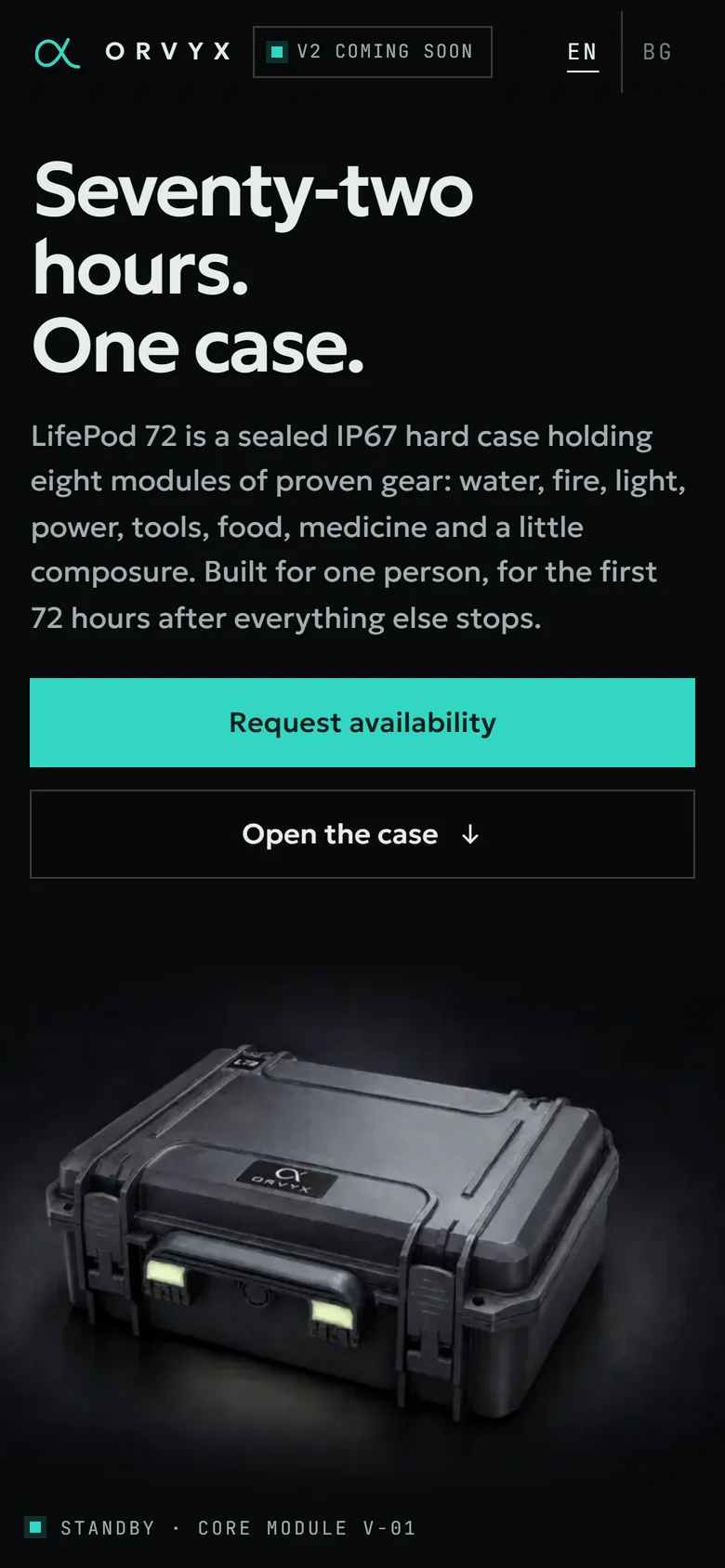
Orvyx
Product site
Product site for LifePod 72 - a sealed IP67 hard case built to keep someone alive for 72 hours.
A launch site in the client's own dark, engineered brand, shipped fast and live today.
Web development studioVarna, BulgariaEst. 2023
Websites and web & mobile applications, designed and built from the first line of code.
Designed and built from scratch, around how your business actually works.
The site a prospect judges you by before they ever speak to you. Designed around what it has to sell, coded from scratch, and tuned for the phone most of your visitors are holding.
Live in 1-3 weeks
Booking systems, marketplaces, client portals, operations and internal tools - web and mobile, built around how your business actually works.
First working release in 2-3 weeks
Already have a site? We rebuild it from the foundations - and your domain, your content and your search rankings come with it.
Live and linkable. Open any of them on your phone.
Product site
Product site for LifePod 72 - a sealed IP67 hard case built to keep someone alive for 72 hours.
A launch site in the client's own dark, engineered brand, shipped fast and live today.
Delivery platform
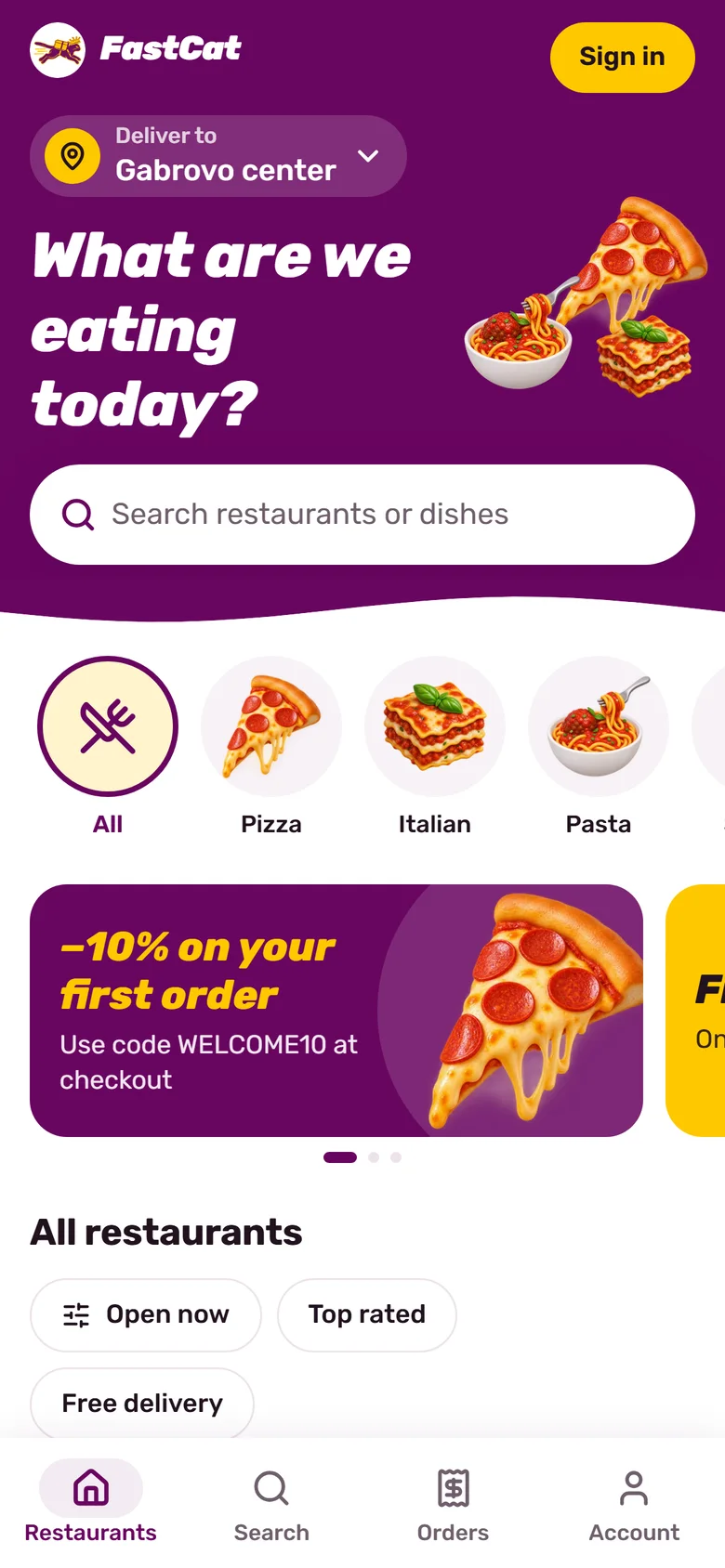
A multi-app food delivery platform, built for a local delivery business in Gabrovo, Bulgaria.
Four apps on one backend: ordering on iOS, Android and web, a restaurant app, a driver app and an admin dashboard, with live tracking on a map.
A local delivery business in Gabrovo was about to sign up for subscription delivery software: a recurring fee, for a platform they would never own. FastCat was built as the alternative - their own platform, under their own brand.
Four apps, one backend
Customers order on iOS, Android and the web from a single Expo codebase. Restaurants run their own app, built to work on Android POS terminals too; drivers have theirs; the business runs everything from a Next.js admin. All four share one Supabase backend and one design system.
Dispatch inside the database
A scheduled job every ten seconds runs the order timers and offers each order to drivers whose location is fresh, never re-offering it to a driver who just declined. There is no separate dispatch server to keep alive.
Security where the data lives
Row-level security on every table and the business logic in database functions, covered by 79 automated database tests. And the whole platform is white-label: a new brand is a config file, not a fork.
Working end to end on live infrastructure within days of the first commit: a customer's order is accepted by the restaurant, dispatched to a driver automatically and tracked live on the map. Cash on delivery works end to end. In final polish, with demo restaurants and no real orders yet; card payments and app store publishing are next.
Launch page
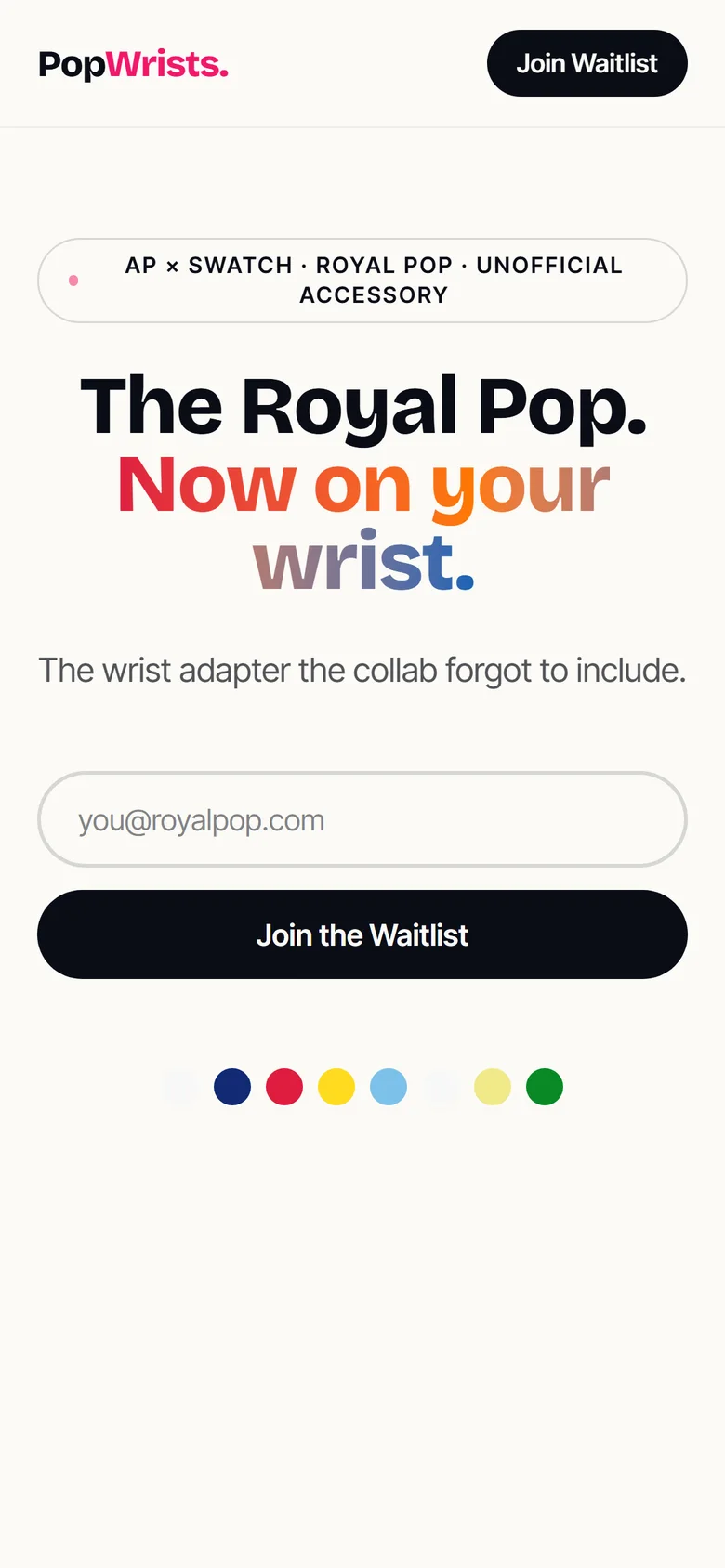
Launch and waitlist site for an unofficial wrist adapter for the AP × Swatch Royal Pop.
Carried by type and colour, with one action: join the waitlist.
Four stages, each ending with something you can hold.
Thirty to forty-five minutes on what it has to do, who uses it, and what's driving the timing. You leave with a clear next step.
Scope, timeline and cost in writing before any code is written. What's included is on paper, and so is what isn't.
A working link from the first week, updated as we build. You check progress whenever you like.
Code, hosting and domain in your name, plus a walkthrough of how it all fits together. Thirty days of fixes included.
The questions that usually come up on the first call.
Websites take one to three weeks. Applications reach a first working release in two to three weeks, and we build on it from there. The exact timeline goes into the written scope.
You do. The repository, hosting and domain sit in your own accounts from launch day.
Every project includes thirty days of fixes. After that, you can keep us on a monthly care plan - hosting, updates, monitoring and small changes - or take the project anywhere you like.
Yes - from the foundations. We don't patch old sites or work in WordPress; a clean rebuild is faster and holds up longer. You keep your domain and content, and we carry your search rankings over through the move.
Yes, as part of application work. When a product needs to live on the phone, the mobile app is built alongside the web platform, on the same backend.
Yes. We work remotely, in English and Bulgarian.
Something else? Ask it in your brief
Miroslav Todorov
Founder & Lead Engineer
Est. 2023Varna, BulgariaEnglish / Bulgarian
Every project we ship is held to the standard of the site you're reading now.
I started Traionis in 2023 to bring the standard of enterprise software teams to businesses of any size, after working inside one myself. Today we build the whole stack, from the interface your customers see to the database behind it.
Tell us what you're building. We'll reply within two working days with next steps.